- September 15, 2026
- Facility Management
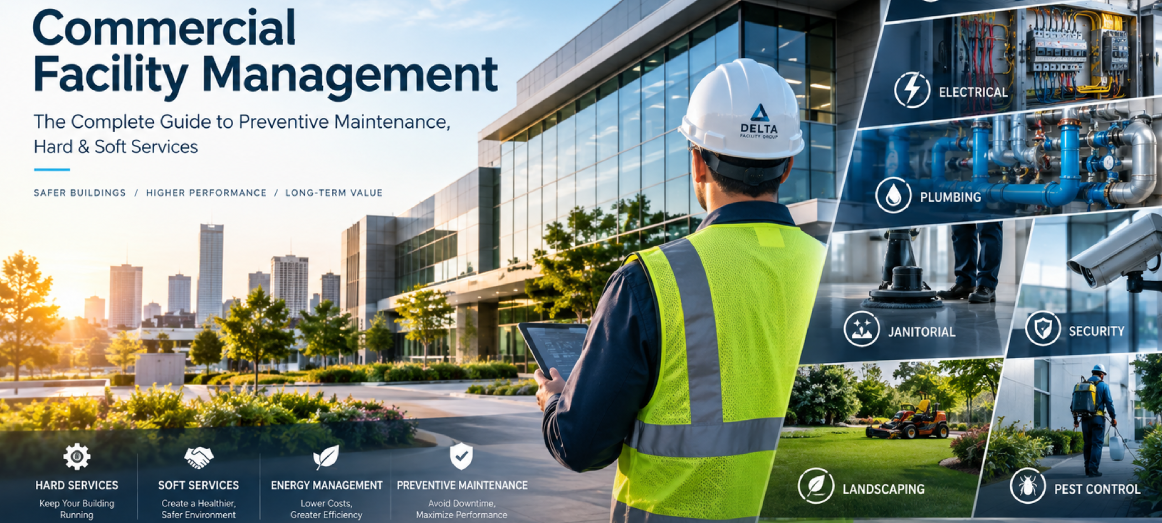
A commercial building is more than walls, floors, equipment, and systems. It is a working environment where HVAC, electrical, plumbing, mechanical systems, security, cleaning, landscaping, fire protection, and building infrastructure must operate together every day.
That is why professional commercial facility management is essential for businesses that want to maintain safe, efficient, reliable, and productive properties.
Effective facility management goes beyond responding when something breaks. A modern facility management strategy combines preventive maintenance, technical services, soft services, energy management, vendor coordination, inspections, emergency response, and long-term building planning.
For commercial property owners and facility managers, the objective is simple: keep the building operating efficiently while protecting its people, assets, reputation, and long-term value.
What Is Commercial Facility Management?
Commercial facility management is the coordinated management of the systems, services, people, and infrastructure required to keep a commercial property operating effectively.
Professional facility management can include both hard facility management services and soft facility management services.
Hard Facility Management Services
Hard services focus on the physical systems and infrastructure that keep a building operational.
These may include:
- HVAC maintenance
- Heating and ventilation
- Electrical systems
- Plumbing
- Mechanical systems
- Fire alarm systems
- Building automation
- Emergency power
- Roofing
- Elevators and lifts
- Refrigeration
- Duct cleaning
- Preventive equipment maintenance
- Building repairs and renovations
These systems require regular inspection, maintenance, testing, and professional intervention to reduce unexpected failures.
Soft Facility Management Services
Soft services focus on the cleanliness, appearance, security, comfort, and day-to-day experience of the property.
They can include:
- Commercial janitorial services
- Day porter services
- Deep cleaning
- Window cleaning
- Security guards
- Pest control
- Landscaping
- Snow and ice removal
- Waste management
- Parking-area maintenance
- Grounds maintenance
- Restoration services
Together, hard and soft services create a complete integrated facility management approach.
Why Preventive Maintenance Matters
One of the most important parts of professional facility management is preventive maintenance.
Instead of waiting for an HVAC unit, pump, electrical component, plumbing system, or other critical asset to fail, preventive maintenance schedules inspections and maintenance before problems become major disruptions.
A properly structured maintenance program can include:
- Asset inspections
- Equipment testing
- Filter replacement
- Electrical inspections
- HVAC cleaning and servicing
- Plumbing inspections
- Mechanical maintenance
- Fire and life-safety checks
- Building-envelope inspections
- Documentation and maintenance reporting
Preventive maintenance turns maintenance from a reactive activity into a planned operational process. Facility-management guidance distinguishes preventive maintenance from predictive maintenance, where equipment condition and operational data can be used to identify developing problems.
HVAC Maintenance for Commercial Buildings
HVAC systems are among the most important systems in a commercial facility.
A poorly maintained heating, ventilation, and air-conditioning system can affect:
- Indoor comfort
- Indoor air quality
- Energy consumption
- Equipment reliability
- Employee productivity
- Operating costs
- Building performance
A professional commercial HVAC maintenance program can include filter replacement, coil cleaning, inspection of motors and belts, airflow checks, control-system inspections, temperature monitoring, and scheduled servicing.
Regular HVAC maintenance can also support energy efficiency. The U.S. Department of Energy notes that operations and maintenance practices can contribute to meaningful energy savings while improving HVAC performance and equipment life.
Electrical Maintenance and Power Systems
Electrical systems are critical to almost every commercial operation.
Professional electrical maintenance can help identify problems before they develop into major equipment failures or operational interruptions.
Facility teams may monitor:
- Electrical distribution systems
- Switchgear
- Panels
- Lighting
- Emergency power
- Generators
- Connections
- Building controls
- Power quality
- Critical electrical equipment
Regular inspections and proactive maintenance help facility managers understand the condition of critical electrical infrastructure and plan repairs or replacements before failures create significant disruption.
Commercial Plumbing and Mechanical Services
Plumbing problems can quickly become expensive commercial property emergencies.
Leaks, blocked drains, failed pumps, water-pressure problems, damaged fixtures, and other plumbing issues can affect employees, customers, equipment, and building operations.
A proactive commercial plumbing maintenance program can include:
- Water-system inspections
- Leak detection
- Drain maintenance
- Pump inspections
- Fixture repairs
- Water-pressure checks
- Preventive repairs
- Emergency plumbing response
Mechanical systems should also be inspected and maintained according to equipment requirements and operational conditions.
The Importance of Soft Facility Management
A building can have perfectly functioning mechanical systems and still provide a poor experience if it is dirty, unsafe, poorly maintained, or badly managed.
This is where soft facility management services become essential.
Professional soft services can include:
Janitorial and Commercial Cleaning
Regular cleaning supports a professional, comfortable, and hygienic environment.
Services may include:
- Daily commercial cleaning
- Restroom sanitation
- Floor care
- Waste removal
- Day porter services
- Deep cleaning
- Window cleaning
- Emergency spill cleanup
Security Services
Commercial security can support the protection of people, property, equipment, and operations.
Security services may include:
- Security guards
- Building access monitoring
- Visitor management
- Parking security
- Site patrols
- Security coordination
Landscaping and Grounds Maintenance
The exterior of a commercial property contributes directly to its appearance and overall condition.
Grounds services may include:
- Lawn maintenance
- Landscaping
- Trimming and pruning
- Tree care
- Leaf removal
- Snow and ice removal
- Parking-lot maintenance
- Sidewalk maintenance
Pest Control
Professional commercial pest control helps identify and address pest activity before it becomes a larger operational or property-management issue.
Regular inspections and preventive treatments can help protect facilities, occupants, inventory, and the building environment.
Energy Management and Building Efficiency
Modern facility management increasingly focuses on energy performance as well as maintenance.
Energy management can involve monitoring building systems, identifying inefficient equipment, improving operating schedules, and addressing maintenance problems that increase energy consumption.
Continuous commissioning and ongoing building optimization can help identify operational problems, improve comfort and indoor environmental conditions, and reduce energy consumption.
Facility managers can examine:
- HVAC performance
- Lighting systems
- Building controls
- Equipment operating schedules
- Energy consumption
- Heating and cooling performance
- Preventive maintenance requirements
The result is a more proactive approach to commercial building energy management.
Reactive vs. Proactive Facility Management
There is a major difference between waiting for problems and actively managing building performance.
Reactive Facility Management
A reactive approach typically means:
Problem → Emergency Call → Repair → Return to Operation
This can result in unexpected downtime, emergency service costs, disrupted operations, and difficult budgeting.
Proactive Facility Management
A proactive approach follows:
Inspection → Maintenance → Monitoring → Early Detection → Planned Repair
This allows facility teams to identify developing issues and address them before they become major operational problems.
Modern facility management increasingly combines preventive maintenance with condition-based and predictive approaches for critical assets.
Why Professional Facility Management Improves Building Performance
Professional facility management brings multiple disciplines together under one coordinated strategy.
Instead of managing HVAC, electrical, plumbing, cleaning, landscaping, security, pest control, and repairs separately, an integrated facility management approach creates a centralized operational structure.
This can improve:
- Building reliability
- Maintenance planning
- Response times
- Operational visibility
- Vendor coordination
- Asset management
- Cost control
- Workplace experience
- Long-term planning
Facility management also involves coordinating vendors and service contracts, including defining service requirements, monitoring performance, and maintaining accountability for the delivered work.
Choosing the Right Facility Management Company
Choosing a facility management partner is an important decision for commercial property owners and organizations.
Before selecting a provider, consider whether the company can support both immediate operational requirements and long-term building objectives.
Look for experience in:
- Commercial building maintenance
- Preventive maintenance
- HVAC
- Electrical
- Plumbing
- Mechanical systems
- Janitorial services
- Security
- Landscaping
- Pest management
- Emergency response
- Restoration
- Vendor management
- Energy efficiency
- Construction and renovation
A strong facility management partner should also provide clear communication, documented maintenance processes, professional technicians, responsive service, and measurable performance.
Why Integrated Facility Management Makes a Difference
Managing multiple building services independently can create communication gaps and inconsistent service.
Integrated facility management brings different services together through one coordinated operational strategy.
For example, an HVAC issue may require mechanical expertise, electrical troubleshooting, controls inspection, and preventive maintenance planning. A water leak may involve plumbing, restoration, building maintenance, and emergency response.
An integrated provider can coordinate these services more efficiently while maintaining a clear understanding of the building’s overall condition.
Facility Management Is More Than Maintenance
The best facility management strategy does not simply repair equipment.
It creates a long-term plan for the entire property.
That means understanding:
What is operating today?
What could fail tomorrow?
What requires preventive maintenance?
Which assets are becoming inefficient?
Which repairs should be planned?
Which services should be monitored through performance standards?
What can be improved to make the building safer, more efficient, and more reliable?
This proactive mindset helps transform facility management from a reactive expense into a strategic part of commercial property operations.
Delta Facility Group: Complete Facility Management Solutions
At Delta Facility Group, we understand that every commercial property has different operational requirements.
Our facility management approach combines hard services, soft services, preventive maintenance, technical expertise, emergency response, building maintenance, and property-support services to help commercial facilities operate reliably.
From HVAC, plumbing, electrical, mechanical, and fire systems to janitorial services, security, landscaping, pest control, restoration, construction, and renovation, our goal is to provide coordinated facility solutions tailored to each property.
Whether you need ongoing preventive maintenance, specialized technical services, emergency support, or comprehensive facility management, Delta Facility Group provides a structured approach designed around your building’s operational needs.
Frequently Asked Questions About Commercial Facility Management
What is commercial facility management?
Commercial facility management is the professional coordination of building systems, maintenance, services, infrastructure, and operational support required to keep commercial properties safe, functional, efficient, and well maintained.
What are hard facility management services?
Hard facility management services involve the physical building systems and infrastructure, including HVAC, electrical, plumbing, mechanical systems, fire protection, elevators, building controls, and other critical assets.
What are soft facility management services?
Soft facility management services focus on the people-facing and environmental aspects of a property, including janitorial services, security, landscaping, pest control, waste management, and grounds maintenance.
What is preventive maintenance?
Preventive maintenance is scheduled inspection, servicing, and maintenance performed to reduce the likelihood of equipment failure and maintain reliable building operations.
Why is HVAC maintenance important?
Regular HVAC maintenance can help maintain comfort, indoor air quality, equipment performance, and energy efficiency while reducing the risk of unexpected system failures.
How often should a commercial building receive maintenance?
Maintenance frequency depends on the building, equipment, usage, manufacturer requirements, environmental conditions, and applicable safety requirements. A professional facility management program should establish schedules based on the specific assets and operational risks of each property.
What does an integrated facility management company do?
An integrated facility management company coordinates multiple building services under a unified management approach. This can include technical maintenance, cleaning, security, landscaping, pest control, energy management, emergency response, and building projects.
Conclusion
A well-managed commercial building does not happen by accident.
It requires planned maintenance, qualified professionals, reliable service partners, continuous monitoring, responsive support, and a proactive facility management strategy.
From HVAC and electrical systems to plumbing, janitorial services, security, landscaping, pest control, restoration, construction, and energy management, every part of a facility contributes to its overall performance.
By moving from reactive repairs toward proactive and integrated facility management, organizations can create more reliable, efficient, comfortable, and well-maintained commercial environments.
Delta Facility Group provides comprehensive facility management solutions designed to keep commercial properties operating at their best.

Loved these reflex drills! Quick hands make such a big difference in pickleball, and these exercises are super easy to add to my warm-up routine.
These tips are spot on! I’ve already tried the wall-bounce drill, and my reaction time at the kitchen line feels noticeably sharper.
Great breakdown! Reaction-time training is often overlooked in pickleball, but these drills make it fun and effective.